Showing posts with label social media. Show all posts

2.02.2010

#DontForgetHaiti, How Social Media Can Help the Restoration

I attended a great Social Media Week panel on the future of Haiti yesterday at the New York Times. While the majority of the discussion analyzed social media and citizen journalism in crisis zones, several Haiti-specific lessons also emerged. Here's video; below are my highlights from the panel.

THE DOCTORS WITHOUT BORDERS STORY

Jason Cone, communications director for Médécins sans Frontières (aka MSF or Doctors without Borders), said that the Haiti earthquake had really been a "game-changer" for his organization. Subscribers to their social media platforms multiplied rapidly and he said that going forward social media would likely be the "most important place we interact with the public," outstripping their main website and the traditional press release model. Their Twitter feed pretty much speaks for itself.

MSF had staff already working in Haiti when the quake hit, so first priority was to make sure their people were alright. The staff mobilized for disaster relief but found that they were "rapidly blazing through emergency supplies," which was compounded by their relief planes not being allowed to land in Port-au-Prince. The control tower was down at the airport and the U.S. Air Force had taken over to direct traffic, but coordination was difficult and MSF planes were diverted to the Dominican Republic multiple times.

This prompted MSF to engage the U.S. Air Force on its Twitter page, with an assist from NBC journalist Ann Curry. Saying to herself, "Lives are at stake," Ann decided to reach out through personal channels to Adm. Mike Mullen to lobby on behalf of MSF and secure access for its relief supplies, including an inflatable hospital. She had seen MSF doctors working literally at gunpoint in other conflict zones and had admiration for the organization's effectiveness. Eventually her networking plus MSF's use of traditional contacts to coordinate flights paid off, but Cone said it was a "firestarter to have this conversation online."

SOCIAL MEDIA AND CITIZEN JOURNALISM IN TIMES OF CRISIS

Moderator Andrew Rasiej of Personal Democracy Forum asked Rob Mackey of the New York Times Lede blog how they filter social media to find relevant information when a major event floods the web with status updates. Mackey indicated that live blogging the 2008 Mumbai attack was nearly impossible, but that techniques have improved since then. The location feature can be useful, but it is still necessary to investigate and verify a person's details. For example, as we saw with the Iran election, Twitter users were encouraged to change their locations to Tehran in "I am Spartacus" solidarity with the protesters, to make it harder for authorities to track and persecute people.

One method is to find a nodal person on the ground such as a photographer and build a filter based on their contacts. Ann Curry did something similar with Luke Renner, a humanitarian worker based in Cap-Haïtien prior to the quake. He reached out to her via Twitter and gave her his phone number. She put him in touch with NBC Nightly News, they vetted him, and the next day she was interviewing him live as cohost of the Today Show.

Later that day her team was en route to Haiti and trying to figure out how to connect with Luke once there, as most of the communications channels were down or unreliable. Through a mix of Blackberries, Twitter, satellite phones, and Skype they eventually managed to coordinate a rendezvous at the airport. Ann's experience of watching Luke start to double as a humanitarian and a citizen journalist drove home the message that "Twitter is teaching people the power of information."

Rasiej asked whether citizen journalism and Haiti have changed our relationship with traditional media. Mackey responded that the change began during the Iran election when hundreds of YouTube videos were uploaded daily. He said that when you're relying on anonymous sources from the web you have to have a transparent discussion with your audience about that fact. Rasiej noted that in some cases the veracity of video clips has even been crowd-sourced, with viewers pointing out continuity mistakes in the shadows of different scenes.

Curry described an emerging ethos where people with useful info express a "real wish to serve" and a desire to "be part of a force for good" by passing that info to the right people or simply retweeting it to their networks. But the buck stops with the reputation of the journalist when it comes to responsibility for vetting the info. If you let yourself be misled you will end up misleading. She mentioned that a lot of biased info came out of Iran, specifically regarding torture, and it was "never backed up."

Cone noted that it is easier to preserve neutrality in a humanitarian situation like Haiti than in a political crisis like Iran. In the case of MSF, their effectiveness depends on depoliticization. He said that in Haiti they turned to traditional radio interviews to debunk rumors that going to a hospital meant certain amputation.

THE EMOTIONAL QUOTIENT

After seeing the horrible human devastation of the earthquake, Curry feels that a lot of humanitarian workers and Haitian citizens alike will need post-traumatic stress counseling. Cone agreed, noting that they have already started to rotate out some of their original response staff, debriefing them in the Dominican Republic. Curry says that seeing bodies everywhere and looking into the eyes of people you know are going to die provokes a lot of survivor's guilt. Psychological restoration in Haiti will be an important component of long-term stability.

On that note, Andrew Rasiej asked whether social media could be used to keep attention focused on Haiti. Cone said MSF will continue its social media efforts despite reconstruction stories being less dramatic than the original event. Ann Curry noted the media's tendency to lapse into disaster fatigue, citing the bloody and drawn-out conflict in Congo, which Nick Kristof revisited again in a recent column. She said network coverage of Haiti started to fade while the topic was still trending high on Twitter. This prompted her to go to her boss and ask if they should cover it more. [Used in this way, there can be self-reinforcing feedback with trend metrics, as people tend to tweet what they're exposed to—a new media Ouroboros.]

Curry also predicted that social media would continue to nourish niche knowledge, speculating that disasters will leave in their wake a "tough core group that continues to be informed," which pretty much sums up the HaitiRewired mission. Rasiej cited stats about mobile phone penetration worldwide, saying we might see global consciousness before we know it, even in places like Congo.

LESSONS FOR FUTURE FOCUS

Several elements emerge from this picture as key focal points for the HaitiRewired community: Fund-raising, Distributed energy, Mobile phones, and Psychological restoration.

It's clear that the success of text-message donations in this crisis means that we'll see a proliferation of organizations using such services the next time disaster strikes somewhere. In this vein, it may also be relevant to explore microfinancing and peer-to-peer donations as a source of sustainable development income.

Communication on the ground is crucial in emergencies, making mobile phone service a priority in Haiti. Of course, the phones and other relief services need power that can't be knocked out easily, which is why a distributed network of energy sources is necessary for resilience.

Finally, the psychosocial restoration of Haiti must be taken into account when exploring design options for urban infrastructure. Of course, the greatest stress relief for the Haitian people would be an end to their crushing poverty.

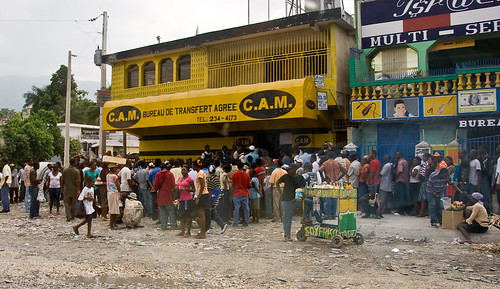
[PHOTO CREDIT: Georgia Popplewell (CC).]

2.20.2009

Social and Political Innovation through Social Media

Last week I attended a great panel on Social and Political Innovation through Social Media as part of Social Media Week NYC. It was hosted by Brian Stelter (@brianstelter) at the New York Times building and organized by Toby Daniels (@tobyd). The panelists included Chris Hughes, co-founder of Facebook and director of online organizing for President Obama's campaign; Andrew Rasiej, founder of Personal Democracy Forum, an annual conference and website covering the intersection of politics and technology; and Jamie Daves, a venture capitalist and entrepreneur with more than ten years of experience in the public sector who has helped found a number of successful nonprofit and political organizations. Here are the highlights from my notes:

Jamie Daves emphasized the disruptive effect new media technologies have always had when they shift the social balance of power to new agents. He also mused whether the two components of democratic capitalism can continue to function in their current forms worldwide given the current trends and uncertainty. Daves said that the rise of social media is creating the largest accrual of social capital we've ever seen. This trend forces corporations to no longer be faceless, and it forces the people who work in business to engage as individuals, leading to an increase in personal responsibility and accountability.

Rasiej said Obama scored points by being the first national candidate to use the pronoun "we." He also noted that an organized minority will always triumph over a disorganized majority, and that social media technologies have lowered the cost of organization.

Chris Hughes noted that the strategy behind my.BarackObama.com was to provide an organizing toolset for supporters to do their own outreach, fund raising, and event hosting.

Rasiej noted that Whitehouse.gov is lackluster so far concerning social media. "Technically every citizen should have their own login," he said. But government doesn't have a Chief Technology Officer to guide things yet, and discussion moderation tools are still imperfect.

Hughes said these things require time, technology, and money. The Bush White House had only one person manning the Web. And the goals are more complex once you're in office, whereas a presidential campaign has one focus: winning.

Daves noted that it was naive of government to be scared of contact when it could actually benefit from the crowd-sourcing of answers. The trick is to connect common strands and the people who weave them. To illustrate his point, Daves cited one of the recent crane crashes here in NYC. There had been numerous citizen complaints about the shakiness of the construction site, but the local government didn't put their comments together into a bigger picture, and the people had no means of finding each other online to amplify their message.

Rasiej said 95 percent of human behavior is about maintaining position, so it's no wonder governments are slow to adapt to new technologies. For example, he came to be known as "wifi guy" when he ran in 2005 for Public Advocate in New York City because he wanted to modernize the city's telecom infrastructure. Nowadays a pejorative and reductive moniker like that might not stick, or might be a positive, because the upside is that social norms change relative to power and technology.

Daves emphasized that the universal service model for broadband connectivity is essential. He cited Pew statistics showing that 75 percent of people 18–24 are active in social networking.

Rasiej replied that older demographics are fast catching up and show some of the strongest growth rates. Globally he said many people will receive a mobile phone before they get access to clean water. Old institutions may fade in the face of these new technologies. One example where mobile phones could prove particularly useful is election monitoring. They may also unleash a new type of grassroots populism. For example, reform of marijuana laws consistently rises to the top of online forums where users are allowed to vote on commonsense priorities for their government.

Daves commented on the roles and responsibilities of old versus new media. We shouldn't look to the New York Times for social solutions, he said. They do a great job articulating the problems, but the mobilization will come from elsewhere.

A question was raised about the economic meltdown and whether this signified a broader meltdown of trust in our society. Hughes responded that transparency is actually natural to Internet technology. Rasiej agreed, stating that in a world of social media it's easier to build than destroy, and there's more vetting than ever before. Everything is recorded, meaning that to fear Big Brother is to fear ourselves.

Another question was raised about the momentum built by the Obama campaign and where it will go now. Hughes, speaking now as a private observer, said they had compiled 13 million emails and that 2 million accounts had been created on my.BarackObama.com, so the infrastructure of a movement does exist and could be channeled into activism, service, and other goals.

A question was raised as to whether social media will chip into the two-party system. Rasiej believes we have drifted into a somewhat post-partisan era where people may be more likely to self-identify as empowered citizens rather than Democrats.

Rasiej also discussed the potential of social media to save politicians from being "sound bited" to death in traditional press conferences. Interactivity can spur a virtuous circle between representatives and their constituents, as was somewhat the case when a cadre of my.BarackObama.com supporters staged the FISA Rebellion, forming a popular group within Obama's own site and threatening to suspend their fund-raising if they didn't get some straight answers from him on warrantless wiretapping. Obama responded directly to prove that he was willing to listen.

Rasiej seemed adamant, however, that social media will not morph government into rule by popular referendum, à la thumbs down in the Coliseum. But I wonder if he isn't being a little preemptive in his reasoning here. If the evolution of technology makes it possible to give more power back to the people, A LOT MORE POWER, why shouldn't it? One can conceive of a People's Digital Parliament rising in parallel to the traditional structures of government and wielding significant influence over legislators. Perhaps it would eventually be annexed to the government as a new branch with specific and limited authority. There may come a day when the dusty documents of a predominantly agrarian society, ingenious though they were, will have to be discarded and rewritten to fit the new ethics, politics, and technologies.

Meanwhile, said Daves, Members of Congress pay attention to four "M" words: Message, Membership, Media, and Money. And Rasiej concluded that there will be no expansion of participatory democracy in America without rebuilding education. Education funding and our view of it has been choked for decades, he said, citing the one hour per week that New York City school children spend on a computer.